
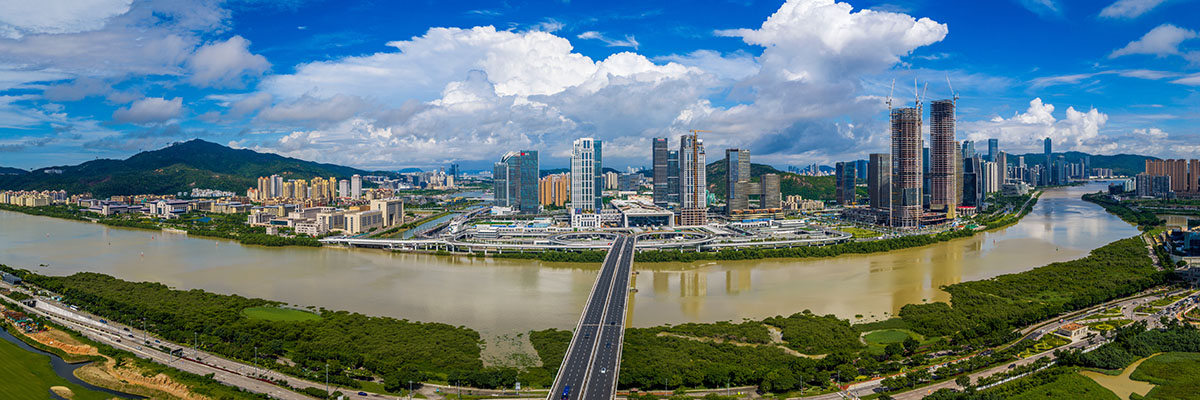
A new paper revealing how polycentric urban regions such as the Guangdong-Hong Kong-Macao Greater Bay Area are actively governed through transcalar state strategies:
Xue, J., Harrison, J. and Hoyler, M. (2026) ‘Beyond state rescaling? Transcalar experimental governance in Guangdong-Macao In-Depth Cooperation Zone, Hengqin’, Transactions in Planning and Urban Research.
Located within the world’s largest urban region, the Guangdong-Macao In-Depth Cooperation Zone in Hengqin (GMH) is a new experimental and innovative governance space connected to China’s ‘one country, two systems’ policy. Located within the geographical boundaries of Zhuhai, the GMH is governed under a shared administrative jurisdiction between Macao, Zhuhai and Guangdong Province. Originally developed from researching African urban contexts, we mobilise and extend a ‘transcalarity’ framework to overcome perceived weaknesses inherent in the ‘state rescaling’ approach often deployed to explain subnational governance arrangements in China. The paper reveals how polycentric urban regions such as the Guangdong-Hong Kong-Macao Greater Bay Area are actively governed through transcalar state strategies. It shows how transcalarity, as a concept, can reveal important new empirical and theoretical insights into urban China. Conceptually, it reframes Hengqin as a ‘buffer zone’ that stabilises yet simultaneously destabilises the ‘one country, two systems’ configuration, producing experimental governance dynamics. Empirically, the paper draws on 39 semi-structured interviews and ethnographic fieldwork, to provide a granular and multi-perspectival analysis of experimental governance practices in the GMH. We demonstrate that central government actors orchestrate polycentric urban development through selective delegation, embedded jurisdictional controls and strategic recalibration of intergovernmental relations. This produces distinctly asymmetrical outcomes: Macao gains institutional leverage, while Zhuhai’s formal administrative authority is constrained. Overall, our paper demonstrates how polycentricity is strategically constructed, rather than emergent, in contemporary state spatial projects.
https://doi.org/10.1177/27541223261485071 (Open access)